
Are Startup Accelerators Worth It? The Real Trade-Offs
· 11 min read
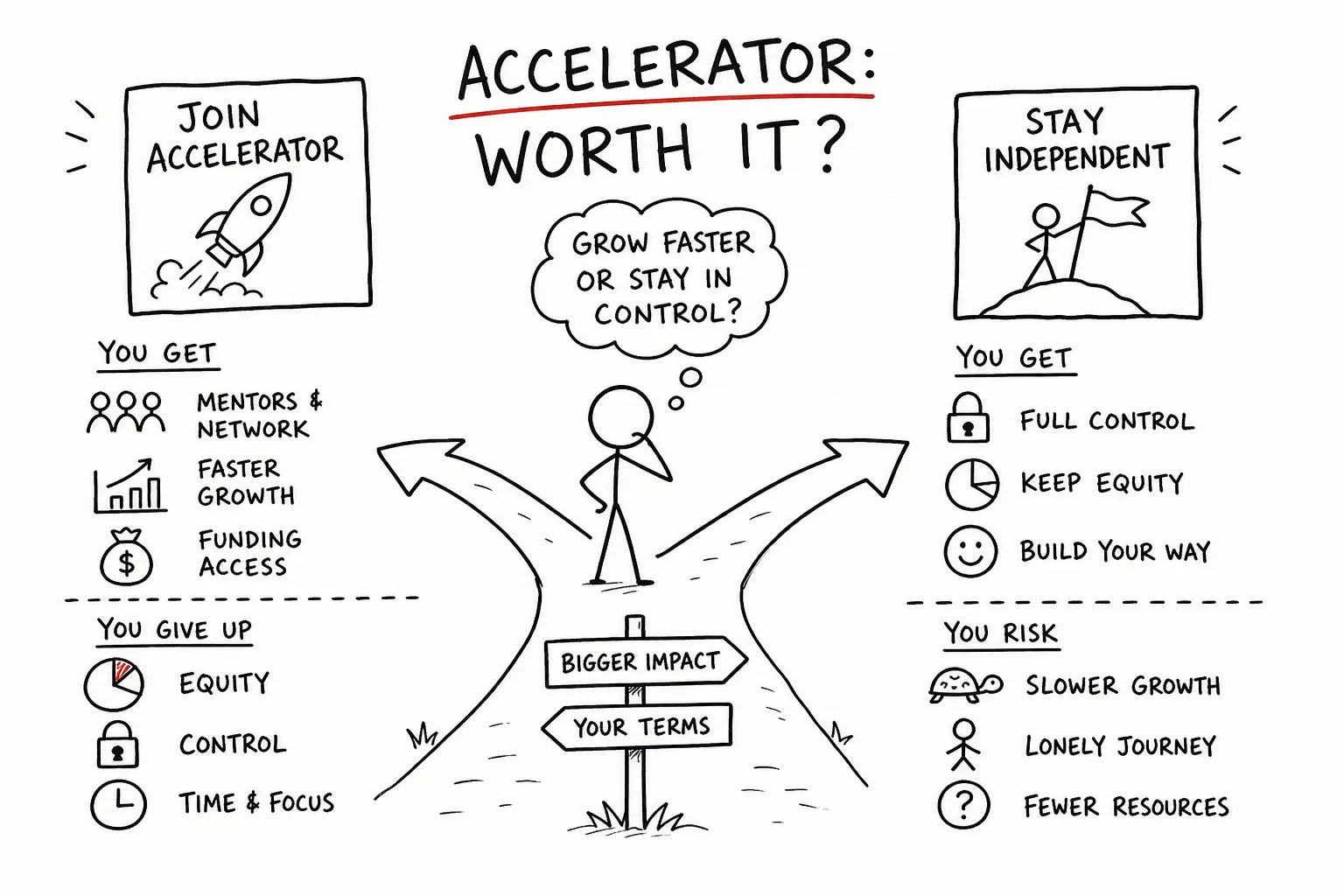
Is a startup accelerator worth it compared to other founder education options? For most founders, the honest answer is no. A study analyzing nearly 750,000 U.S. startups found that roughly 60–80% of accelerator programs produce outcomes no better than skipping a program entirely. Only a narrow elite, Y Combinator and Techstars among them, consistently outperforms the baseline on fundraising, revenue, and early growth.
That doesn't mean you skip founder education. It means you need to match the format to your actual stage, your goals, and what you're willing to give up. This article breaks down what accelerators really cost, what you actually get in return, and how the main alternatives compare, so you can make a clear-eyed call with real numbers, not reputation.
Events like Startup School Conference have started to challenge the assumption that a 12-week cohort is the only credible path to serious founder education. There are more options than most founders realize, and the best one for you depends on factors most program marketing conveniently ignores.
Key takeaways
- Equity cost is real: Top accelerators take 5–7% of your company at seed stage, and the true dilution compounds significantly by Series A.
- Outcomes vary sharply by program: Elite programs like YC and Techstars deliver measurable fundraising gains; most others don't move the needle.
- Survival rates don't improve: Accelerators speed up outcomes; they don't improve your odds of staying alive long-term.
- Alternatives are legitimate: Incubators, one-day conferences, and targeted mentorship deliver real value at a fraction of the cost and commitment.
- Stage determines fit: An accelerator earns its equity cost only when you have traction, a clear fundraising timeline, and access to a top-tier program.
- Verify before committing: Alumni outcomes, mentor relevance, and actual cap table math should drive the decision, not brand prestige.
Is a startup accelerator worth it? What it actually costs you
The equity math most founders underestimate
Y Combinator currently takes 7% for $500,000 total, structured across two SAFEs: $125,000 on a post-money SAFE and $375,000 on an uncapped SAFE with MFN provisions. Techstars takes roughly 5% for approximately $220,000. Those headline percentages sound manageable until you model what they look like at a Series A. If your accelerator holds 7% pre-Series A and a Series A investor takes 20% of the post-money company, your 7% shrinks and the founders' stake compresses significantly in the same transaction. A program that takes an uncapped SAFE on top of its equity stake can dilute founders more than the brochure suggests.
The real calculation isn't "what percentage does the accelerator take?" It's "what does the fully diluted, post-conversion cap table look like after my Series A closes?" Most founders don't run that model before signing.
The time and opportunity cost
Twelve to sixteen weeks of full-time focus means paused sales cycles, delayed product work, and sometimes a relocated team. For a pre-product founder with nothing but an idea, that cost is low. For a founder with paying customers and active deals, it's significant, real money left on the table. The program schedule doesn't pause because your best prospect is ready to close.
This isn't a scheduling inconvenience. It's a strategic trade-off, and it should be treated as one. Before applying, calculate what 90 days of full-time program attendance costs you in delayed revenue, deferred hiring, and paused partnerships.
What the acceptance rate math tells you
Y Combinator accepted fewer than 1% of applicants in its most recent published cohort, selecting 260 companies from more than 27,000 applications. Techstars runs similarly below 1% for most programs. Even applying to these programs is a non-trivial time investment: writing applications, preparing pitches, conducting interviews. For most founders, the odds alone make a top-tier accelerator a low-probability bet. Applying to weaker programs to improve your chances is exactly the wrong strategy, because the data shows weaker programs don't move the needle.
What do founders actually get in return?
The case for accelerators, with real numbers
Accelerator participants raise approximately $1.8 million more on average after the program and are 23% more likely to raise a subsequent round than comparable non-accelerated ventures. Participants also planned to raise roughly $2.64 million more over the year following the program. These are real effects, not marketing copy. The strongest accelerators deliver three tangible assets: mentor networks (offered by 83% of programs), investor introductions (offered by about 48%), and cohort credibility that signals quality to the market.
About 40% of YC graduates raise a Series A, compared to roughly 20–25% for Techstars graduates. Those numbers are meaningfully above the baseline for comparable startups. The credential matters, but only from programs where it actually carries signal.
Where accelerators consistently disappoint
Founders report a consistent set of drawbacks across post-program surveys. Mentor quality is the most common complaint: 87% of founders prefer advice specific to their business, but many programs rotate generalist mentors who offer the same guidance regardless of sector, stage, or business model. Pressure to optimize for demo day over actual business development is widely cited. Programs designed around a pitch event can push founders toward metrics that look good on slides rather than economics that work in the real world.
A large early ownership block also creates cap table complications. Some investors view a 7–10% accelerator stake as a red flag at Series A, particularly if the program's follow-on rights or anti-dilution provisions add friction. A widely cited longitudinal study finds that approximately 50% of founders who went through programs outside the top tier report little or no improvement in outcomes. That's not a rounding error.
The survival rate reality check
Accelerated startups do not survive at meaningfully higher rates than non-accelerated ones. A large-scale longitudinal study finds no statistically significant difference in overall survival between cohorts. The real effect is speed: stronger startups scale faster, and weaker ones identify failure sooner. That's genuinely useful, but it isn't the same as a survival guarantee, and it's not what most program marketing implies when it talks about "increasing your odds of success."
Is a startup accelerator worth it compared to other founder education options?
Founders don't need to know every option. They need to know the five real choices and what each one trades off.
| Format | Cost | Time | Equity dilution | Best for |
|---|---|---|---|---|
| Top-tier accelerator (YC, Techstars) | $0 fee, 5–7% equity | 12–16 weeks, full-time | High | Startups ready to raise VC immediately |
| Incubator / cohort program | $0–$10K | 3–6 months, part-time | Low to none | Pre-product or pre-revenue stage |
| Entrepreneurship MBA | $100K–$200K+ | 2 years | None | Career pivots, foundational business skills |
| Online courses / bootcamp | $0–$7,500 | 4 weeks to 5 months, flexible | None | Specific skill gaps, early validation phase |
| One-day founder conference (e.g., Startup School Conference) | $125–$350 | 1 day | None | Seed to Series A founders needing concentrated curriculum fast |
Comparing accelerators vs. other founder education options: why the one-day format deserves a serious look
Startup School Conference compresses capital, operations, brand, and exit strategy into a single day at the University of Denver, taught by 25+ exited founders, venture investors, and M&A attorneys. Tickets run $125 to $350, and you give up zero equity. The curriculum spans four breakout tracks with small-group working sessions, a mainstage program featuring investors who have deployed billions, and an evening networking reception designed specifically to connect founders with capital sources and operators, not just other founders.
For founders who can't commit 12 weeks or 7% of their company to a program, this format offers a high-ROI entry point into serious founder education. The Startup School Conference Workbook compiles every framework from the day so you leave with something you can actually implement Monday morning, not just a pitch deck critique and a LinkedIn connection.
What none of these formats replace
Real learning still comes from doing: customer interviews, pricing experiments, sales calls, and investor conversations. Every education format should be evaluated by how much it accelerates those real-world reps, not how impressive the name looks on a LinkedIn profile. Any program, conference, accelerator, or MBA, that doesn't push you toward faster iteration in the actual market isn't earning its cost, whatever that cost happens to be.
When does an accelerator actually make sense?
The stage and goal filter
An accelerator earns its equity cost when specific conditions align: you genuinely need the program's investor network, cohort credibility matters in your sector, and you're positioned to fundraise within 12 months of graduating. If any of those conditions aren't met, the ROI calculation shifts against the program. A founder who isn't ready to raise, targeting a sector the accelerator doesn't cover, or applying to a program without demonstrable investor access is paying equity for something they won't use.
The questions to ask before applying
Before committing to any accelerator application, get specific answers to the following: What percentage of the last three cohorts raised a Series A within 18 months? What does the check actually net to the company after fee deductions? Are the listed lead mentors active in your sector and at your stage? What does the cap table look like at a $3 million versus a $10 million Series A given the program's SAFE terms and any follow-on rights? Programs that can't answer these questions directly are telling you something important.
Red flags that signal a weaker program
Generic advice that applies to every company equally, no trackable alumni fundraising data, a curriculum designed around demo-day performance rather than business fundamentals, and mandatory full-time relocation without corresponding investor access are all signals that a program sits in the 60–80% that underperform the baseline. A program's website should make it easy to find specific alumni outcomes. If you have to dig, that's the answer.
How to pick the right education path for your stage
A decision framework
Start with your stage. If you're pre-product, an incubator or cohort program builds the foundation without giving up equity prematurely. If you have paying customers but haven't raised outside capital, a concentrated one-day curriculum fills the knowledge gaps on fundraising, cap tables, and operations without pulling you off your business for three months. If you're within 12 months of a deliberate fundraising push and can get into a top-tier program, the accelerator's investor access may justify the equity cost. If you need broad business fundamentals and time isn't the constraint, an MBA serves a different purpose entirely.
The factor most founders skip is the specific knowledge gap. An accelerator is not a substitute for a clear answer to the question: "What do I not know that's actually slowing down my company right now?" If the answer is "investor introductions at the Series A level," a top-tier accelerator is relevant. If the answer is "I don't understand how to read a term sheet or structure a cap table," a one-day intensive with the right practitioners covers that faster and cheaper.
The checklist before you commit to any program
Take these concrete steps before signing anything, whether it's an accelerator, a bootcamp, or any other program. First, verify alumni outcomes through direct conversations with graduates, not testimonials on the program website. Second, model the equity dilution at multiple future valuation scenarios: a flat outcome, a $5 million Series A, and a $15 million Series A. Third, confirm that the specific mentors listed are actually accessible during the program, relevant to your business model, and not simply names borrowed for marketing purposes. Ask the program directly: "Which mentor will I meet with regularly, and what's their background in my sector?"
One approach that often gets overlooked
For founders at the seed-to-Series A stage, combining a concentrated one-day event for curriculum density with a targeted mentorship relationship and one focused online course often delivers more practical progress than a 12-week program, at a fraction of the time and cost. Startup School Conference is designed specifically for this stack-and-apply model: attend the mainstage and two breakout sessions, leave with the workbook, and connect with the investors and operators you met at the networking reception. That's a full curriculum in a single day, with no equity attached.
The bottom line on accelerator ROI
So, is a startup accelerator worth it compared to other founder education options? For most founders, the math doesn't hold up. Accelerators make sense for a narrow set of founders: those with product-market traction, a clear fundraising timeline within 12 months, and access to an elite program. For everyone else, the equity cost and time commitment are hard to justify given the quality of alternatives available. The 60–80% of programs that underperform the baseline aren't delivering education. They're selling the idea of education.
The best founder education matches your stage, fills your actual knowledge gap, and respects your cap table. That calculation looks different at every company. Make it with real numbers: model the dilution, verify the alumni outcomes, and ask the uncomfortable questions before you apply.
Before you spend 12 weeks and 7% of your company on a program, consider spending one day with practitioners who have actually built and sold businesses. Startup School Conference on November 5, 2026 at the University of Denver offers exactly that. It's worth attending before you decide whether a longer, more expensive commitment makes sense for where your company actually is.
Frequently Asked Questions
If I have paying customers and active deals, should I join a 12-week accelerator program?
Probably not. Joining a 12–16 week accelerator is likely a significant opportunity cost if you have paying customers and active deals. A full-time program can pause sales cycles, delay product work, and leave real money on the table, so you should calculate what 90 days of attendance costs in delayed revenue, deferred hiring, and paused partnerships before committing.
How should I model the equity dilution from an accelerator before signing?
Model the fully diluted post-conversion cap table across multiple future valuation scenarios. Run several scenarios, such as a flat outcome, a $5 million Series A, and a $15 million Series A, so you understand how SAFEs and follow-on rights affect your stake.
What's the best way to verify an accelerator's alumni outcomes?
Talk directly to graduates rather than relying on testimonials or website claims. Ask them for specific cohort fundraising rates and Series A conversion timing rather than marketing materials.
Can I combine education formats instead of doing a full accelerator?
Yes, combining a concentrated one-day event with targeted mentorship and a focused online course often delivers more practical progress than a 12-week program. This stack-and-apply approach is especially useful for seed-to-Series A founders, and a one-day intensive like Startup School Conference plus a workbook and follow-up mentorship can be high ROI with no equity given up.