
Series A Funding Explained: What Investors Actually Want
· 10 min read
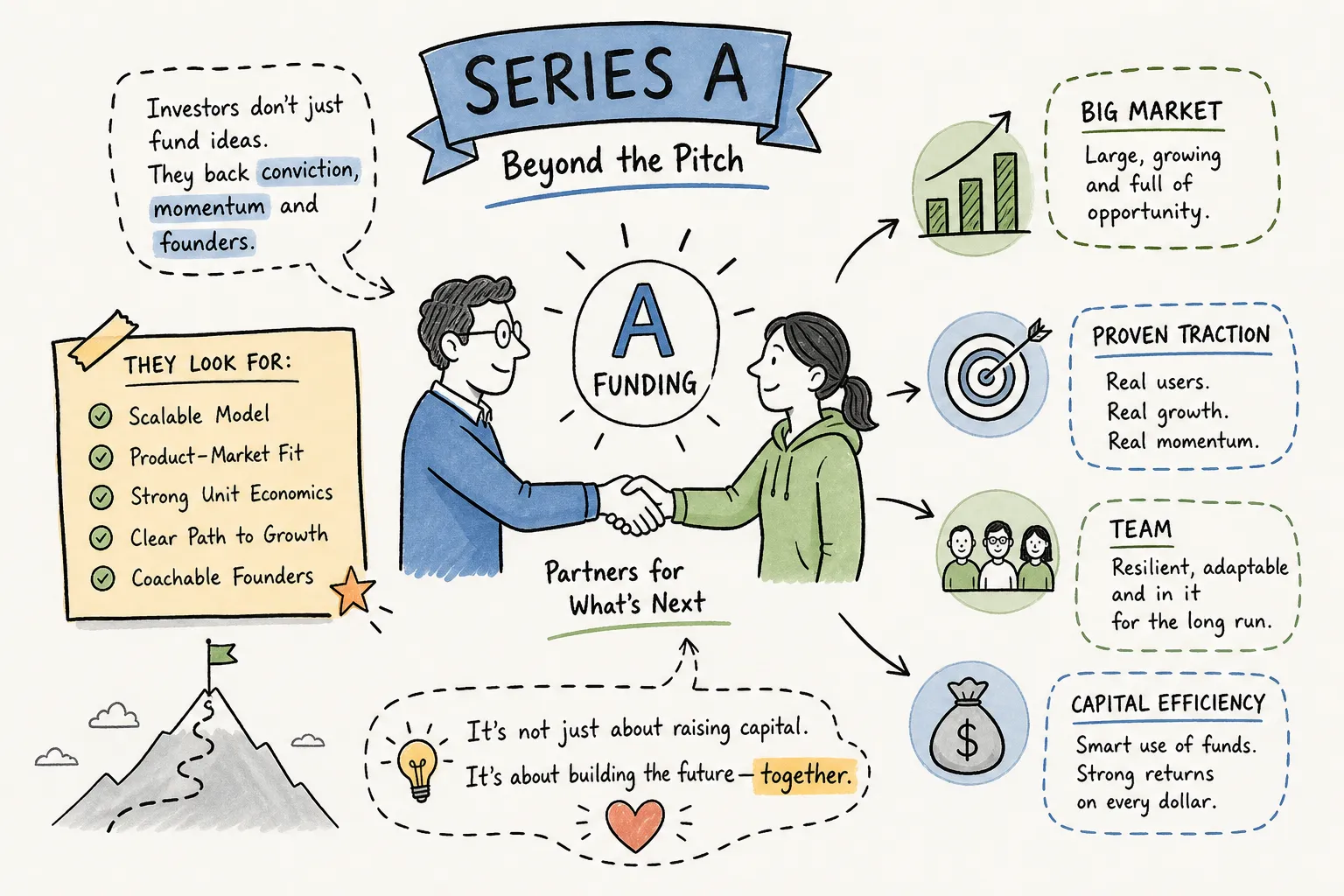
Series A funding explained: a Series A round is a startup's first major institutional equity financing after seed. It funds the transition from a working product with early traction to a repeatable, scalable business. Most Series A rounds in the U.S. raise between $5M and $25M, with pre-money valuations ranging from $25M to $60M+ depending on industry and traction, based on 2026 market benchmarks across venture-tracked deals. The investors writing these checks are not betting on your potential anymore. They're evaluating your evidence.
This guide covers what a Series A actually is, how it differs from seed and later rounds, what metrics investors require by industry, what the term sheet means in plain terms, and how to honestly assess whether you're ready to raise. If you're a seed-stage founder beginning to think about this round, the answers here draw on practitioner frameworks and 2026 investor benchmark data, not classroom theory.
Key takeaways
Series A funds scale: It's not about proving your idea works. It's about proving your business model is repeatable and growing consistently.
Metrics vary by model: B2B SaaS targets $1M to $3M ARR, 80 to 120% YoY growth, and NRR above 110%, per 2026 SaaS benchmark data. Consumer, biotech, and marketplace companies are measured differently.
Valuation is negotiated: B2B SaaS companies typically see 7 to 9x ARR multiples at Series A, with pre-money valuations commonly in the $25M to $50M range, based on 2026 sector-specific comparables.
The option pool shuffle matters: Pool expansion before closing dilutes founders more than the headline investor percentage suggests. Model the full cap table before you agree to anything.
Legal housekeeping is non-negotiable: A clean cap table, Delaware C-corp structure, signed IP assignments, and founder agreements in place are baseline requirements before approaching investors.
Timing is a strategic decision: Founders who wait to hit stronger metrics, often six months longer than feels comfortable, tend to secure better Series A terms.
Series A Funding Explained: What a Series A Round Actually Is
Seed investors fund exploration: an idea, an MVP, or a very early product with limited traction. Series A investors fund a working business. The product is live, demand is demonstrated, and there's real evidence the model can scale. That distinction sounds simple, but it changes everything about how you prepare, what you pitch, and who will take your meetings.
The jump from seed to Series A is not about time. It's about proof. A company that raises a seed round in January and hits $2M ARR with 120% year-over-year growth by August is more ready for a Series A than a company that has been building for three years with flat revenue. Readiness is measured in evidence, not elapsed months.
Series B is a separate conversation. Series A finances the development of a repeatable business model. Series B finances scaling a model that already works across distribution, sales, and operations. Each subsequent round demands less tolerance for uncertainty, not more. If Series A is about proving the engine runs, Series B is about flooring the accelerator.
Institutional venture-capital firms lead Series A rounds: early-stage specialists, multi-stage generalists, and sector-focused funds. The lead investor typically contributes 30 to 60% of the round, negotiates the term sheet, and takes a board seat. Syndicate investors and existing seed-round participants join on the same terms. The lead is your primary institutional partner after closing, which makes fit and chemistry at least as important as check size.
Series A Funding Explained: Key Metrics Investors Actually Require
For B2B SaaS, the benchmarks Series A investors consistently apply are $1M to $3M in ARR, 80 to 120% year-over-year growth, and net revenue retention above 110%. LTV to CAC ratio of at least 3:1 and CAC payback under 12 to 18 months round out the first part of the scorecard. Gross margins tracking toward 70%+ complete the picture. These are not suggestions. Investors use these figures to filter inbound before they take the first call.
Metrics shift meaningfully by industry. Consumer companies are evaluated on cohort retention, repeat purchase rate, and contribution margin rather than ARR alone, with typical raises in the $3M to $8M range. Biotech Series A rounds center on clinical data, IP, and capital required to hit the next value inflection, with a market median around $18M. Marketplaces are measured on GMV, take rate, net revenue, and cohort transaction retention rather than subscription-style ARR.
Consistency matters more than a single great month. Investors want to see sustained 8 to 15% month-over-month growth across multiple quarters. They will look at whether growth comes from one channel or many, and whether your acquisition cost is improving or worsening over time. A burn multiple below roughly 2x is increasingly expected alongside strong growth, a threshold that has become a standard screening filter among institutional Series A investors. One impressive quarter surrounded by flat months tells a different story than three consecutive quarters of steady expansion.
B2B SaaS benchmarks at a glance
ARR of $1M to $3M, NRR above 110%, and 80 to 120% year-over-year growth are the three numbers most institutional Series A investors check first. If any one of these is materially off, the other two rarely compensate for it on their own.
Consumer and marketplace benchmarks
Consumer investors prioritize D30 and D90 cohort retention alongside contribution margin. Marketplace investors focus on GMV growth trajectory, net revenue, and whether take rate is holding as volume scales. Neither category uses ARR as the primary filter.
How Much Can You Raise and at What Valuation?
U.S. Series A rounds in 2026 typically land between $5M and $25M across most sectors, based on current venture market data. B2B SaaS companies most commonly target $12M to $18M at a $30M to $50M pre-money valuation. Biotech and capital-intensive categories skew higher, often $20M to $40M+, which pulls blended market medians upward. When you read that the median Series A valuation is $78M post-money, remember that number includes categories where $50M rounds are routine.
For B2B SaaS specifically, the most reliable benchmark from 2026 SaaS multiple data is 7 to 9x ARR, with a practical midpoint around 8x. A company with $3M in ARR implies a valuation somewhere between $21M and $27M on that basis, before growth rate, retention, market size, and competitive dynamics are applied. A company growing 120% year-over-year commands a different multiple than one growing 60%, even at identical ARR.
The option pool shuffle is the part most founders miss. Most term sheets require the employee option pool to be expanded before closing, and because it's created pre-money, existing shareholders, primarily founders, absorb that dilution before the new investor's shares are issued. A headline pre-money valuation of $20M with a 15% post-money pool requirement can feel closer to an effective $17M to founders. Model the fully diluted cap table before you agree to a valuation. Do not benchmark your deal against blended market medians. Use sector-specific comparables from companies at your stage and growth profile.
What's Actually in a Series A Term Sheet?
Series A investors receive preferred stock, not common stock. Preferred shareholders get paid before common shareholders in a sale or liquidation. The standard formulation is 1x non-participating preferred: the investor receives their original investment back first, then converts to common stock if that produces a larger return. They do not receive both. Participating preferred, which lets investors take their liquidation preference and then share in remaining proceeds alongside common shareholders, is more investor-favorable and worth scrutinizing carefully during negotiation.
Anti-dilution provisions protect investors if the company raises a later round at a lower price. Broad-based weighted average anti-dilution is the standard at Series A. It adjusts the conversion price proportionally based on both the new lower price and the number of shares issued. Full ratchet resets the conversion price to the new lower price regardless of how few shares are issued. Full ratchet is significantly harsher and uncommon in standard Series A deals; if you see it, flag it with your counsel immediately.
Board composition, founder vesting, and protective provisions all carry more long-term weight than most first-time founders realize. Investors typically receive one board seat. Founders negotiate whether they retain majority control or share it equally, often with an independent seat added later. Existing founder shares are frequently subject to re-vesting on a four-year schedule with a one-year cliff, with the amount and credit for time served open to negotiation. Protective provisions give preferred holders veto rights over major actions like selling the company or issuing new securities, but not over day-to-day operations. The scope of those provisions matters as much as the label on the round.
Term sheet clause checklist
Before you sign, confirm you understand the liquidation preference structure, the anti-dilution mechanism, board seat composition, founder re-vesting terms, and the full list of protective provisions. Each clause has a long-term consequence. None of them are boilerplate once a real exit event arrives.
How to Know If Your Startup Is Actually Ready to Raise
Your product needs to be live and generating real, collectible revenue. Not pilots. Not heavily discounted design-partner contracts. Investors want to see revenue that demonstrates a customer valued the product enough to pay a real price for it. You also need at least one repeatable, scalable customer acquisition channel beyond founder-led sales, and a team with the key roles in place, or credibly identified, to deploy capital effectively across sales, product, and engineering.
Your cap table needs to be clean. No ambiguous equity promises, unresolved IP assignments, or founder disputes. The standard corporate structure for venture-backed companies is a Delaware C-corp with signed founder agreements, properly documented prior financings, and existing SAFEs or convertible notes already accounted for in the dilution math. Surprises at closing are expensive and sometimes fatal to deals.
The honest question most founders avoid is whether their metrics actually support the round they want to raise. Raising on weak traction with a great pitch is a short-term solution with a long-term cost: unfavorable terms, a valuation you'll struggle to grow into, or a down round when the next milestone arrives. If your NRR is below 100% or your growth rate is inconsistent, more capital won't fix the problem. It will amplify it. Founders who wait to hit stronger metrics, often six months longer than they expect, consistently secure better Series A terms.
A practical readiness checklist
Before you start investor conversations, confirm all of the following: real, collectible revenue at target ARR; at least one scalable acquisition channel beyond founder-led sales; a clean Delaware C-corp cap table with all IP assigned; signed founder agreements with no unresolved disputes; and existing SAFEs or notes fully accounted for in your dilution model.
Where Founders Get Straight Answers on Series A Readiness
Many founders focus on slide polish before getting direct feedback from active Series A investors on what they actually need to see first. Reading blog posts gives you general frameworks. It does not prepare you for the specific, uncomfortable questions an investor will ask about your cohort retention curves, your CAC payback by channel, or why your NRR is 105% instead of 115%.
Startup School Conference (November 5, 2026, University of Denver) puts seed and early Series A founders in the same room as active investors and recently-funded founders. Seth Levine of Foundry is among the practitioners on faculty. The capital track breakout sessions run in small-group formats, which means founders get direct, specific answers about their readiness rather than panel-style generalities that apply to no one's actual situation.
There's a meaningful difference between knowing the benchmark metrics and understanding how an investor actually weighs them against each other when a company hits some but not others. Founders who attend leave with a concrete picture of where their business stands and what needs to change before they approach the market. At $125 for general admission, Startup School Conference delivers the kind of investor-level clarity most founders spend months trying to find on their own.
The Bottom Line: Series A Funding Explained
A Series A round is not a milestone you chase. It's the result of building a business that investors find undeniable. The metrics matter. The term sheet mechanics matter. Your operational readiness, not your ambition, is what ultimately determines whether you raise on good terms or settle for bad ones. With series a funding explained from metrics to term sheets to readiness, the framework is clear. What remains is the execution.
Start with the fundamentals in this guide. Know your numbers cold. Clean up your legal house before you start conversations. Then go have the conversation with someone who's actually writing these checks, not someone who's written about them.
Frequently Asked Questions
What do investors focus on during due diligence beyond headline metrics?
Investors dig into unit economics, cohort retention, CAC payback by channel, cap table cleanliness, and IP assignments during due diligence. They will want verifiable revenue that is collectible, evidence of repeatable acquisition channels beyond founder-led sales, and clean legal housekeeping like signed IP assignments and a Delaware C‑corp structure.
How does the option pool expansion before closing actually affect founder ownership?
Expanding the option pool pre-money dilutes existing shareholders, primarily founders, before the new investor's shares are issued. That means a headline pre-money valuation can feel lower to founders in practice, so you must model the fully diluted cap table before agreeing to terms.
Is a Delaware C‑corp required to raise a typical institutional Series A?
Usually, yes. Most institutional investors expect a Delaware C‑corp with proper corporate documentation and signed founder agreements, although C-corps in some other states with favorable tax treatment are increasingly accepted. Surprises like ambiguous equity promises or unresolved IP assignments can be fatal to deals, so you need that structure and clean cap table in place.
How long should founders consider waiting to improve traction before pursuing Series A?
Often about six months longer than feels comfortable, to hit stronger metrics before raising. Founders who do so consistently secure better Series A terms, because investors are evaluating sustained evidence and consistency rather than a single great month.